

Pipeline Coating Removal: Induction vs Abrasive Blasting for External Pipe Coatings
Induction heating loosens a pipe coating from the wall so it can be scraped off; abrasive blasting takes it off and leaves a profile ready for recoating. What each method costs per metre and what to check before a quotation.
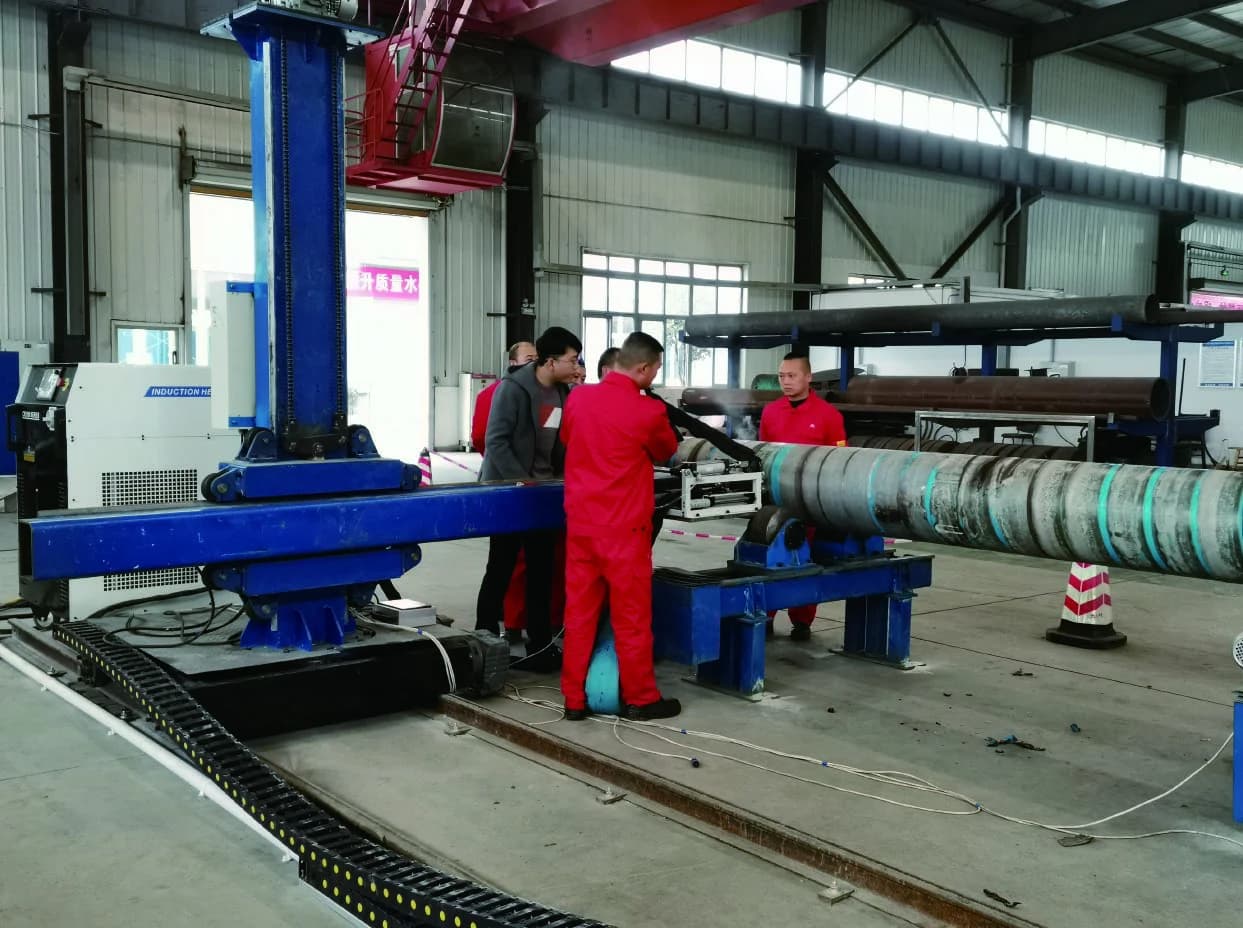
Induction heating and abrasive blasting remove an external pipe coating by different means, and they leave the pipe in different states. Induction loosens the coating from the pipe wall so it can be scraped off and collected; blasting takes the coating off with an abrasive and leaves a profile the next coating system can accept. Which one costs less depends on the coating, the pipe diameter, the access and what the surface has to look like at the end.
The two are often compared as if they do the same job. They do not, and the difference shows up in the last step rather than the first: the state of the steel when the crew packs up. This article sets out what each method does to a pipe, what has to be checked before either is used, and where induction is the wrong answer.
What each method does to the pipe
| Induction heating | Abrasive blasting | |
|---|---|---|
| What it acts on | The bond between the coating and the pipe wall | The coating itself, carried by an abrasive |
| How the coating leaves | Scraped off in sheets and flakes, collected | Carried away as abrasive and coating dust |
| Waste | The removed coating only | Coating plus the spent abrasive |
| Surface afterwards | Coating gone; primer, rust and no profile | Coating gone; a defined profile for the new system |
| Secondary work | Usually needed before recoating | Usually not needed |
| What it suits | Steel, with the tool matched to the diameter | Most substrates |
Read that table as the cost argument, not as a quality judgement. Induction wins on the equipment line and on the waste line. Blasting wins on the finishing line, because the surface it leaves is what a coating specification asks for. A job where the pipe has to be ready for a new coating system without further preparation is often cheaper by blasting, even though the blasting itself costs more.
What the coating itself decides
External pipe coatings are not one material. Bitumen, coal tar epoxy, polyurethane, glass flake epoxy and the polyolefin multi-layers used on long distance lines all behave differently, and the heat needed to release them changes with the material and the thickness. That is why the operator's own coating documentation and a test on a representative section matter more here than any general description of the process.
Two numbers are worth having before the conversation starts: the measured coating thickness, and the wall thickness of the steel underneath it. The second one decides whether the heat can be used at all. Thin pipe carries the heat through to the other side, where it can reach the far coating, a seal, a valve or a cable. Pipe wall thickness is not a detail to be checked later; it is the first thing to check.
Access decides the schedule
Pipeline work happens in awkward places: above ground in a trench, inside a tunnel, over a water crossing, on a rack inside a plant, or on an offshore platform. The tool has to reach the outside of the pipe and keep reaching it along the section. A large diameter cannot be worked from one side with a short lead, and the crew often has to work both sides of the pipe, sometimes at height.
This is also where the two methods separate most clearly. Blasting needs an enclosure around the pipe to hold the abrasive and the dust, and somewhere for the spent media to go. Induction needs a power supply and cooling on site and produces debris that has to be collected, but it does not need an enclosure.
None of it works on a line that is carrying product. Heating a pressurised line is not a decision the equipment makes: it belongs to the operator of the pipeline, who has to accept the temperature limit for the whole system rather than for the section being worked on. If a line is in service, the work waits for a shutdown, and a quotation should be written on the assumption of a shutdown.
Where the money goes
For a pipeline job the delivered cost per metre is assembled from the same items as any other surface preparation work:
- Equipment and mobilisation. A power source, a chiller, a transformer and the tool packs have to reach the site, and on a remote route they may travel a long way to get there.
- Removal labour. The heat releases the coating; a person still scrapes it off. This is the largest line on most pipeline jobs.
- Access and working height. Working over a trench or on a platform costs more per metre than working on a level bed.
- Waste removal. Blasting produces abrasive and coating waste; induction produces coating debris. Both leave the site.
- Surface preparation afterwards. The step that decides whether induction was cheaper at all.
- Isolation and traffic management. On a live route this is often the largest line of all, and it has nothing to do with the method.
One specification point belongs here rather than in a brochure. The 60 kVA all-in-one unit runs at half duty above 40 kVA, while the 30 and 60 kVA split-type power sources and the 30 kVA all-in-one run continuously. For a straight pipeline run that is the difference between a machine that works all day and one that has to stop. The configuration therefore follows the shift pattern of the job, not only the pipe diameter. The CR2100 platform page lists the models, the output and the cooling arrangement.
What induction coating removal does not do
- It is not a method for a line in service. Heating a line carrying product under pressure needs the operator's approval and a review of the temperature limit of the whole system.
- It does not leave a surface ready for coating. Primer, rust and the profile of the bare steel still have to be dealt with.
- It is not a general answer for every material. The heat has to be absorbed by a steel pipe. Other substrates need their own validation.
- It comes with no thickness limit. There is no general figure that applies to every coating and every pipe. A test on a representative section is what produces the number.
- It is not cheaper because it is new. The comparison is made on cost per metre of finished pipe, including the preparation afterwards.
What to check before a quotation
- Steel grade and wall thickness. The minimum thickness that can take the heat.
- The coating system. Material, layer structure, measured thickness, and the safety data of the old coating.
- Pipe diameter and the length of the run. These set the tool, the access and the crew.
- Where the pipe is. Above ground, in a trench, on a platform, over water. It changes the mobilisation more than the method does.
- Whether the line is in service. If it is, the work is planned around a shutdown.
- What the surface has to be ready for. The coating system that follows decides whether further preparation belongs to this job or the next one.
The pipeline coating removal application page sets out the same questions for pipeline work, and which step comes first on a thick coating job covers where induction and laser cleaning divide the work. Send the pipe data through the contact form and the configuration can be reviewed against the actual run.
Frequently asked questions
Can induction heating remove a bitumen coating from a pipeline?
Bitumen is among the coatings that release under heat, and the answer still comes down to the same three things: the steel wall thickness underneath, the measured thickness of the coating, and the tool matched to the pipe diameter. A test on a representative section of the actual pipe settles it. No general description of the process settles it for a specific line.
Is induction cheaper than sandblasting for pipe coating removal?
On the equipment line and the waste line, usually yes: there is no abrasive to buy, transport or dispose of, and the coating leaves as solid debris. The finished result can go the other way. Blasting leaves a profile a coating specification can accept directly, while induction leaves the steel to be prepared. The comparison that settles it is cost per metre of pipe that is ready for the new coating system.
How long does the work take on a pipeline?
The figure that matters is not the heating rate but the delivered rate: the metres of pipe per day with the coating removed, the debris collected and the surface in the state the next step needs. That number comes from a test and from the access on the day, and it is what a quotation should be written against. The published rate for the equipment is a figure with stated conditions, not a promise about a specific route.