

Understanding the Difference Between Gaussian and Top-hat Laser Beams
When it comes to laser applications, the shape of the laser beam plays a crucial role in determining its effectiveness. Two common beam profiles are Gaussian and top-hat beams . Here ’ s a brief…
Understanding the Difference Between Gaussian and Top-hat Laser Beams
When it comes to laser applications, the shape of the laser beam plays a crucial role in determining its effectiveness. Two common beam profiles are Gaussian and top-hat beams. Here’s a brief overview of how they differ:
1. Gaussian Beams
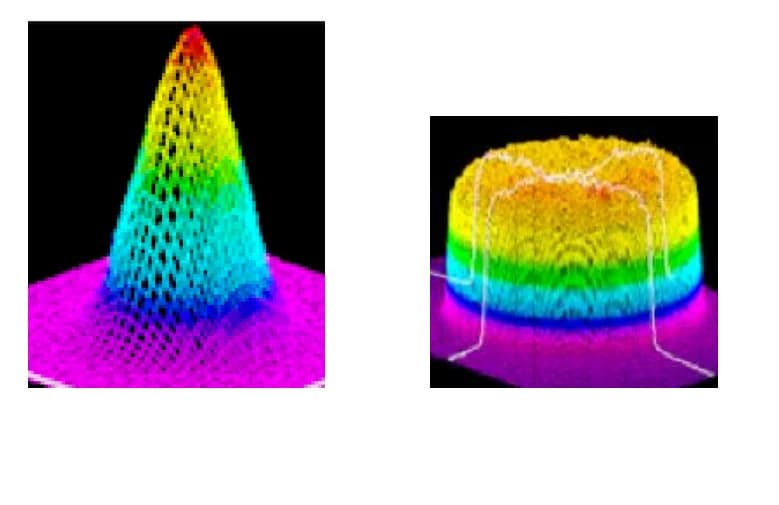
A Gaussian beam is characterized by its intensity distribution, which follows a bell-shaped curve. The highest intensity occurs at the center, and it gradually decreases as you move away from the center. This profile is ideal for applications that require focused, high-intensity light, such as laser cutting or welding. However, due to the intensity drop at the edges, it might not be suitable for tasks where uniform power distribution is necessary.
2.Top-hat Beams
In contrast, a Top-hat beam has a uniform intensity across the beam profile, with little to no variation across its cross-section. This makes Top-hat lasers ideal for processes that require consistent power distribution over a larger area, such as surface treatment or materials processing. While they may not focus as tightly as Gaussian beams, the uniformity in intensity offers greater control for many industrial applications.
Key Differences:
- Intensity Distribution: Gaussian beams have a peak at the center and decrease at the edges, while Top-hat beams maintain a consistent intensity across the beam.
- Application Suitability: Gaussian beams are often used for high-precision, focused applications; Top-hat beams are better suited for tasks requiring even energy distribution.
In summary, the choice between Gaussian and Top-hat beams depends on the specific needs of the application, with each offering distinct advantages in different contexts.